Cross Validation
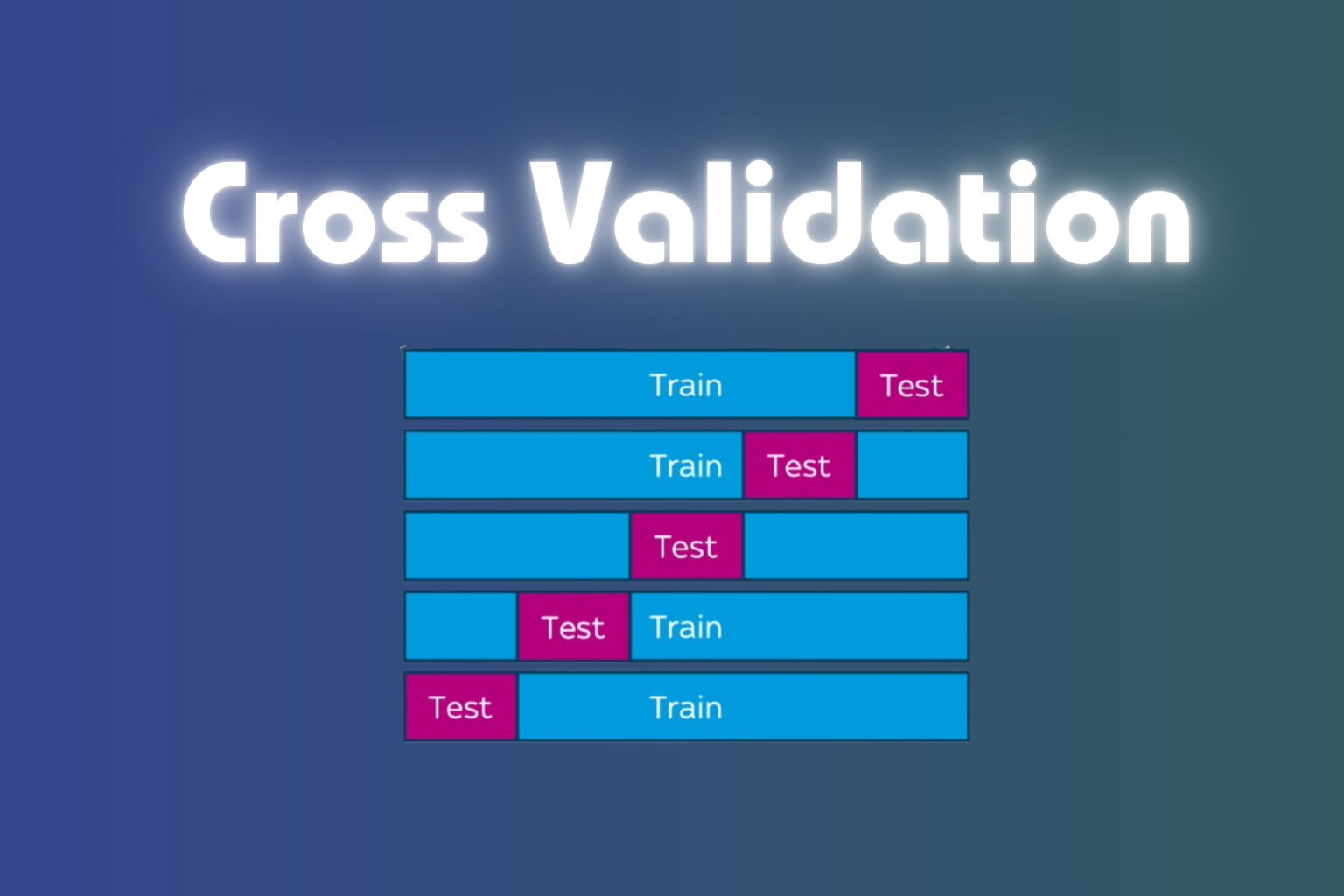
Definition
Cross-validation (CV) is an advanced evaluation technique where the model is trained and tested multiple times using different splits.
Unlike hold-out (which uses only one split), CV reduces variance and gives a more reliable performance estimate.
Use Cases of Cross-Validation
-
Small or medium datasets:
Uses every observation for training and testing. -
When accuracy matters a lot:
Gives reliable model performance estimates. -
Model selection & hyperparameter tuning:
Used with GridSearchCV and RandomizedSearchCV. -
Detecting overfitting/underfitting:
CV scores show consistency across folds.
Benefits of Cross-Validation
-
More reliable evaluation:
Uses multiple splits → more stable results. -
Reduces overfitting risk:
Checks performance consistency across folds. -
Uses dataset efficiently:
Each sample becomes both train and test at least once. -
Standard in machine learning research:
Recommended for accuracy-sensitive tasks.
Limitations of Cross-Validation
-
Computationally expensive:
Trains the model many times. -
Not ideal for very big datasets:
Especially slow for deep learning. -
Some models may not support CV easily:
(e.g., models requiring sequential data) -
Complicated implementation for time-series data: Careful handling needed to avoid data leakage.
Train-Test Split vs Cross-Validation
| Aspect | Train–Test Split / Hold-Out | Cross-Validation |
|---|---|---|
| Number of splits | 1 | Many |
| Speed | Fast | Slow |
| Accuracy stability | Fluctuates | Stable |
| Best for | Large datasets, quick tests | Small/medium datasets, serious evaluation |
| Data usage | Limited | Full dataset is used |
| Risk of bias? | High | Low |
Types of Cross-Validation
1. K-Fold Cross-Validation (Most Common)
The dataset is split into K equal parts (folds). Process:
- Train on K–1 folds
- Test on the remaining fold
- Repeat K times
- Average all scores
Typical values: K = 5 or 10
Use Cases
- When dataset is small or medium-sized
- For model selection and hyperparameter tuning
- When data is not time-dependent
- Good general-purpose evaluation method
Benefits
- Low bias, low-to-moderate variance
- Efficient use of data
- Works for both classification and regression
- Stable and widely used
Limitations
- More computationally expensive than hold-out
- Must shuffle data properly
- Still not ideal for time-series data
2. Stratified K-Fold (For Classification)
Same as K-fold but keeps class ratios the same across folds.
Used when data contains imbalanced classes.
Use Cases
- When the dataset is imbalanced
- Classification tasks where each fold must maintain class proportions
- Ensures fair evaluation of minority/majority classes
Benefits:
- Preserves target class distribution
- Prevents folds with missing classes
- More reliable than normal K-fold for classification
Limitations:
- Only works for classification
- Slightly slower due to stratification step
3. Leave-One-Out Cross-Validation (LOOCV)
If dataset has N samples, then N folds.
Each iteration:
- Train on N–1 samples
- Test on 1 sample
Very accurate but slow.
Use Cases:
- Very small datasets (e.g., less than 100 samples)
- When you want to use almost all data for training
- For sensitive scientific/statistical applications
Benefits:
- Uses the maximum amount of data for training
- Very low bias
- Useful when dataset is too small for splitting
Limitations:
- Extremely slow for large datasets
- High variance (since each test set is only 1 sample)
- Not practical for most ML problems
K-Fold vs Stratified K-fold Vs LOOCV
| CV Type | Best For | Benefits | Limitations |
|---|---|---|---|
| K-Fold | General use | Stable, widely used | Slow on big data |
| Stratified K-Fold | Imbalanced classification | Balanced folds | Only for classification |
| LOOCV | Very small datasets | Max training data | Too slow |