Day 3 of My End-to-End ML Project
(Where Raw Data Meets Production Pipeline)
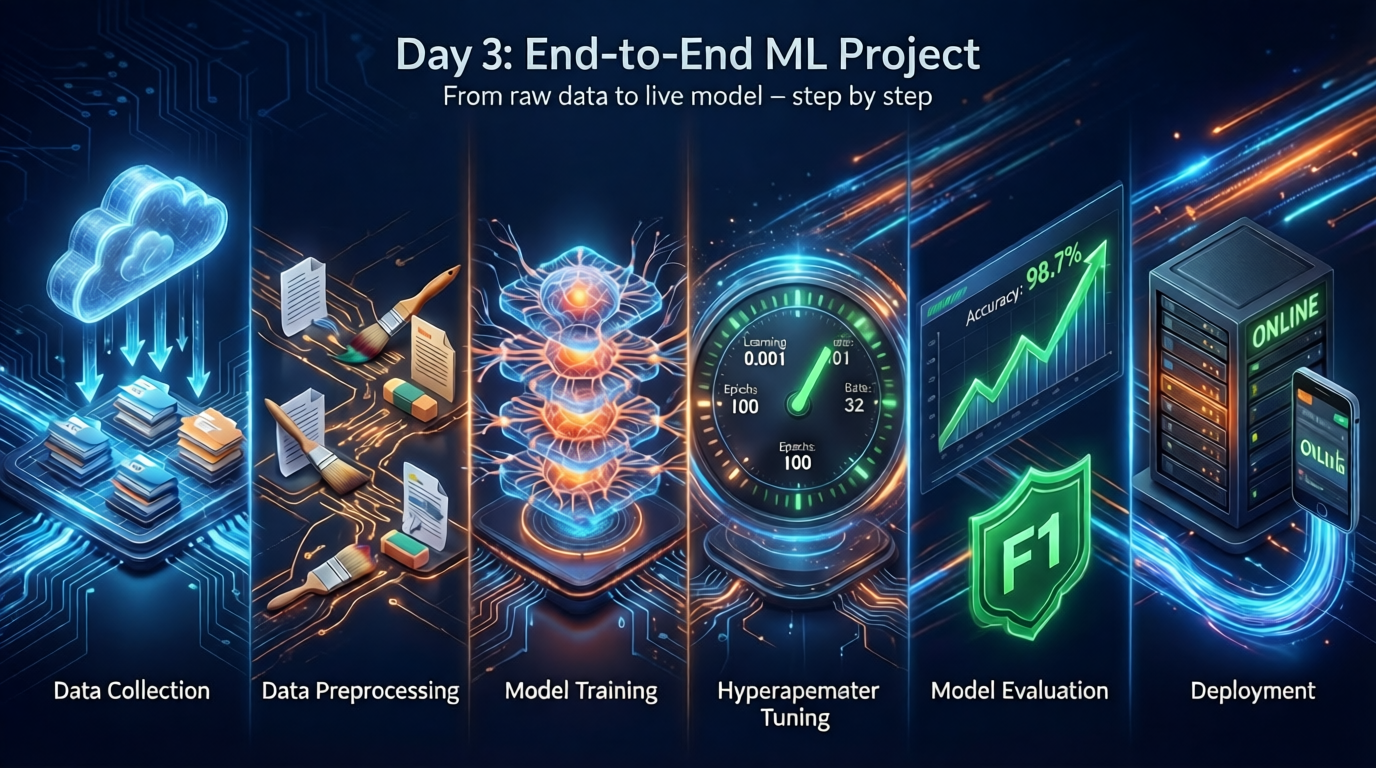
No models trained yet. But today, I built the data bloodstream (=the flow of data through your ML system) that will feed every future prediction.
Yesterday I gave my project a nervous system (logging + exceptions). Today I built its circulatory system (=the infrastructure that moves data reliably)—the components that move raw data through cleaning, transformation, and into model-ready form. Still no algorithms. Still no accuracy metrics. But without this foundation? Any model I train tomorrow would be built on quicksand.
Here’s how I engineered two critical pipeline components that separate production ML from notebook experiments.
The Two Pillars of Data Preparation
In an end-to-end ML system, data doesn’t magically appear model-ready. It flows through two sequential stages:
| Component | Responsibility | Production Criticality |
|---|---|---|
data_ingestion.py |
Raw data → Clean artifacts (train/test splits) | Prevents “data drift” between experiments |
data_transformation.py |
Raw features → Numerical tensors (with preprocessing pipeline) | Eliminates data leakage; enables inference reproducibility |
Let’s dissect each component’s architecture and why its design choices matter.
data_ingestion.py: The Data Gatekeeper
This component is the single source of truth for raw data entry into the system. Its job: ingest once, split once, artifact forever.
Core Responsibilities
# src/components/data_ingestion.py (annotated highlights)
@dataclass
class DataIngestionConfig:
    raw_data_path: str = os.path.join('artifacts', 'data.csv')
    train_data_path: str = os.path.join('artifacts', 'train.csv')
    test_data_path: str = os.path.join('artifacts', 'test.csv')
-
Immutable artifact storage: All outputs land in
artifacts/—a sacred directory never manually edited. Why?- Reproducibility: Same raw data → same train/test split across runs
- Auditability: Trace every experiment back to exact data version
- CI/CD readiness: Artifacts become inputs for automated training jobs
-
Real-world data cleaning baked in:
# Critical fix: Spaces and slashes break downstream pipelines!
df.columns = df.columns.str.replace(' ', '_', regex=True).str.replace('/', '_', regex=True)
logging.info(f"Renamed columns: {df.columns.tolist()}")
→ Spaces in column names (
"math score") cause silent failures in scikit-learn pipelines. This proactive sanitization prevents 3 AM debugging sessions. -
Train/test split as a component, not a script:
train_set, test_set = train_test_split(df, test_size=0.2, random_state=42)→ Encapsulating the split inside a class method ensures every pipeline run uses identical splitting logic—no more “why did my accuracy change?” mysteries.
Why This Beats Notebook-Style Data Loading
| Notebook Approach | Production Component Approach |
|---|---|
df = pd.read_csv("data.csv") in cell 3 |
DataIngestion().initiate_data_ingestion() |
| Manual train/test split in cell 5 | Encapsulated split with fixed random_state |
| Outputs saved ad-hoc | Structured artifacts with versioned paths |
| No logging of data shape/schema | Full audit trail via logging.info() |
| Result: Fragile, non-reproducible | Result: Reproducible, auditable, testable |
Key insight: In production ML, data versioning is as critical as code versioning. The
artifacts/directory becomes your data version control system.
data_transformation.py: The Feature Alchemist
This component performs the most dangerous operation in ML: converting raw features into numerical tensors without leaking test data into training. One mistake here invalidates your entire model evaluation.
The Architecture: Defense-in-Depth Against Data Leakage
# src/components/data_transformation.py (critical sections)
def get_data_transformer_object(self):
    numerical_columns = ['writing_score', 'reading_score']
    categorical_features = [
        'gender', 'race_ethnicity', 'parental_level_of_education',
        'lunch', 'test_preparation_course'
    ]

    # Numerical pipeline: median imputation → standardization
    num_pipeline = Pipeline([
        ("imputer", SimpleImputer(strategy="median")),
        ("scaler", StandardScaler())
    ])

    # Categorical pipeline: mode imputation → OHE → scaling (without centering!)
    cat_pipeline = Pipeline([
        ("imputer", SimpleImputer(strategy="most_frequent")),
        ("one_hot_encoder", OneHotEncoder(handle_unknown='ignore', sparse_output=False)),
        ("scaler", StandardScaler(with_mean=False))  # Critical: sparse matrices can't be centered
    ])

    # Unified preprocessor: routes columns to correct pipelines
    preprocessor = ColumnTransformer([
        ("num_pipeline", num_pipeline, numerical_columns),
        ("cat_pipeline", cat_pipeline, categorical_features)
    ])
    return preprocessor
Why This Design Prevents Catastrophic Errors
| Risk | Mitigation in This Implementation |
|---|---|
| Data leakage | fit_transform() ONLY on train data; transform() on test data |
| Unknown categories at inference | handle_unknown='ignore' in OHE prevents runtime crashes |
| Sparse matrix scaling errors | with_mean=False for categorical features (sparse matrices can’t compute mean) |
| Silent imputation failures | Explicit strategy="median"/"most_frequent" instead of defaults |
| Pipeline reproducibility loss | Entire preprocessor saved as preprocessor.pkl via save_object() |
The Golden Rule: Fit on Train, Transform on Test
# CORRECT: Learn statistics from TRAIN only
input_feature_train_arr = preprocessing_obj.fit_transform(input_features_train_df)

# CORRECT: Apply TRAIN-learned rules to TEST
input_feature_test_arr = preprocessing_obj.transform(input_features_test_df)
→ If you fit_transform() on test data, your model “sees” test set statistics during training. Your reported accuracy becomes fiction. This component enforces the boundary.
Artifact Preservation: The Inference Lifeline
save_object(
    file_path=self.data_transformation_config.preprocessor_obj_file_path,
    obj=preprocessing_obj  # Contains ALL learned parameters (means, stds, OHE categories)
)
→ Without this saved preprocessor.pkl, your deployed model would fail on new data. Raw inputs would bypass transformation, causing shape mismatches or nonsensical predictions. This artifact bridges training and inference.
How These Components Fit Into the Larger Pipeline
Today’s work completes Stage 1 of the training pipeline:
┌──────────────────────────────────────────────────────────────┐
│                    TRAINING PIPELINE (Stage 1)               │
├──────────────┬───────────────────┬───────────────────────────┤
│  Component   │      Input        │         Output            │
├──────────────┼───────────────────┼───────────────────────────┤
│ DataIngestion│ Raw CSV           │ artifacts/train.csv       │
│              │                   │ artifacts/test.csv        │
├──────────────┼───────────────────┼───────────────────────────┤
│ DataTransform│ train.csv/test.csv│ artifacts/train_arr.npy   │
│              │                   │ artifacts/test_arr.npy    │
│              │                   │ artifacts/preprocessor.pkl│
└──────────────┴───────────────────┴───────────────────────────┘
                              ↓
                    [Tomorrow: ModelTrainer]
Critical Integration Points
-
Logger integration: Every major step logs with timestamps:
[2026-01-29 10:23:45] 38 DataIngestion - INFO - Read the dataset as dataframe.
[2026-01-29 10:23:46] 52 DataIngestion - INFO - Train-test split initiated.
[2026-01-29 10:24:01] 47 DataTransformation - INFO - Obtaining preprocessing object.
→ Full observability without
print()statements polluting production logs. -
Exception safety net: Any failure triggers
CustomExceptionwith precise file/line context:except Exception as e: raise CustomException(e, sys) # Auto-logs with traceback enrichment→ No silent failures. No cryptic
KeyErrorwithout context. -
Standalone testability: Both components include
__main__blocks for isolated validation:python src/components/data_ingestion.py → Outputs: "Data ingestion standalone test completed!" → Validates artifact creation WITHOUT running full pipeline
Validation: Proving the Data Bloodstream Flows
Before trusting this with model training, I validated the full data flow:
# Execute ingestion → transformation chain
python src/components/data_ingestion.py

# Verify artifacts created
ls artifacts/
→ data.csv    train.csv    test.csv    preprocessor.pkl

# Inspect log for validation clues
grep "preprocessing object" logs/*/2026_01_29_*.log
→ "Saved preprocessing object."
→ "Applying preprocessing object on training and testing dataframes."
This evidence-based validation prevents the #1 ML project killer: “It worked yesterday but not today.”
Real-World Lesson: The Column Renaming Fix
During testing, I discovered a silent killer:
# Original column name from dataset:
"math score"  # Contains space!

# Without renaming:
df["math score"] → Works in pandas
But breaks in ColumnTransformer which expects valid Python identifiers
My fix:
df.columns = df.columns.str.replace(' ', '_', regex=True).str.replace('/', '_', regex=True)
→ Lesson: Raw data is never pipeline-ready. Production systems must sanitize inputs at ingestion, not during transformation. This is why data ingestion is a dedicated component—not a preprocessing step.
Day 3 Checklist Complete
data_ingestion.pyimplemented with artifact management- Column sanitization (spaces → underscores) baked into ingestion
data_transformation.pywith leakage-proof preprocessing pipelines- Numerical/categorical feature handling with proper imputation strategies
- Preprocessor saved as
preprocessor.pklfor inference reproducibility - Standalone validation tests for both components
- Full integration with Day 2’s logging/exception infrastructure
- Artifact directory populated with:
artifacts/data.csv(raw)artifacts/train.csv/test.csv(split)artifacts/preprocessor.pkl(transformation rules)
Tomorrow’s Mission (Day 4): The Brains Arrive
With the data bloodstream flowing, tomorrow I’ll build the model training component:
-
Implement
utils.pywith:save_object(): Generic pickle serializer for artifactsevaluate_models(): Cross-validation runner for algorithm selection
-
Implement
model_trainer.pywith:- Multiple algorithm training (LinearRegression, RandomForest, XGBoost)
- Hyperparameter tuning via GridSearchCV
- Best model selection based on R² score
- Model artifact saving as
model.pkl
-
Critical integration: Load
train_arr.npyfrom today’s transformation → train models → save best performer
The pipeline will finally close the loop: raw data → features → predictions.
Why Day 3 > Model Training for Long-Term Success
| Activity | Short-Term “Cost” | Long-Term Impact |
|---|---|---|
| Training first model | “Feels productive” | Model becomes obsolete when data schema changes |
| Building ingestion/transformation | “No accuracy metric yet” | Pipeline survives data schema changes, new features, production deployment |
The brutal truth: Models are disposable. Pipelines are permanent. A well-engineered data preparation layer lets you swap algorithms weekly without touching infrastructure. A fragile notebook-style loader breaks with every CSV format change.
Follow my end-to-end ML journey: GitHub Repo Link Day 3 complete. Data bloodstream flowing. Tomorrow: the brains (model training) arrive.
Key Takeaways:
- Data ingestion isn’t “just loading CSVs”—it’s the foundation of reproducibility via artifact management
- Data transformation’s #1 job: prevent data leakage through strict fit/transform separation
- Column sanitization at ingestion prevents silent pipeline failures downstream
- Saving the preprocessor.pkl is non-negotiable for inference reproducibility
- Production ML isn’t about algorithms—it’s about building data bloodstream that never breaks
What’s your biggest data preparation horror story? Did a space in a column name ever break your pipeline at 2 AM? Share below!